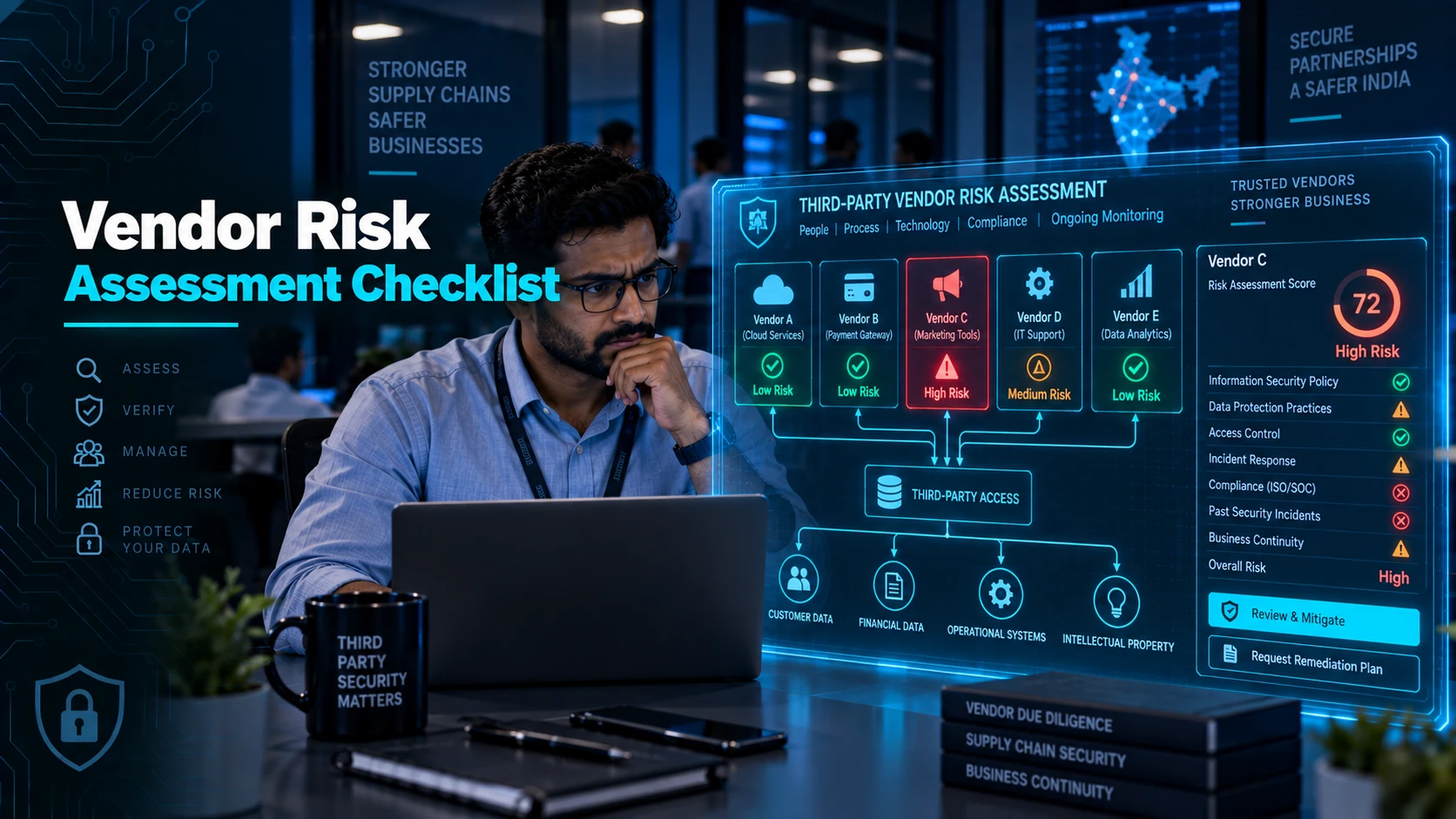
What Questions Should You Ask a Vendor Before Giving Them Data Access?
A vendor's weak security can become your breach — here's a practical checklist for assessing third-party risk before you hand over system or data access.

💡 In Simple Terms (For Beginners)
Third-party risk means a supplier, IT contractor, or software vendor you work with can become the way attackers get into your business — because their weak security, not yours, is the actual entry point.
- Vendor access is often granted once and never reviewed again — that's where real risk accumulates.
- A short, practical question set surfaces most vendor risk without needing a formal procurement process.
- MSMEs are frequently targeted specifically as an easier vendor-based entry point into larger clients.
THREAT INTEL · September 11, 2026 · 7 min read · By Hardik Patel
What questions should you ask a vendor before giving them data access? Ask what access they actually need versus what they're requesting, how they'll notify you if they're breached, and whether that access will ever be reviewed or revoked — three questions that surface most vendor risk before you sign anything.
The Core Questions to Ask Every Vendor
A short, direct set of questions catches most vendor risk before access is even granted:
- What specific access do you need, and for how long? Standing, broad access granted "for the engagement" and never revisited is the single most common vendor risk pattern.
- Will you notify us if you experience your own breach? If a vendor can't answer this clearly, that's itself informative.
- Where will our data actually be stored, and by whom? A vendor's own sub-contractors can quietly extend your exposure further than expected.
- Do you have basic security practices in place — patching, access controls, staff training? You don't need a full audit, just an honest answer.
- Who at your organisation is our point of contact for a security concern? A vague answer here often reflects a vague internal security process too.
Why Scope Matters More Than Trust
Scoping a vendor's access narrowly to exactly what their task requires protects you regardless of how much you trust the vendor personally, because the risk isn't usually the vendor acting maliciously — it's the vendor being compromised by someone else and that access being used against you.
This is distinct from vendor payment fraud, which is about a fraudster impersonating a vendor to redirect a payment. Vendor risk assessment is about the vendor's actual security posture and the access they genuinely hold — a different exposure that needs its own checklist.
Building This Into a Repeatable Process
The fastest way to build a repeatable vendor risk process is a simple inventory: list every vendor with system or data access, rank them by how much access they actually have, and review the highest-risk relationships first — most businesses find their biggest gaps in relationships nobody had flagged as a security concern.
Setting a review cadence — quarterly, or at contract renewal, whichever comes first — keeps access from silently accumulating the way it does when it's set once at onboarding and never revisited.
Key Takeaways
- Five direct questions surface most vendor risk before access is even granted.
- Scope access narrowly regardless of how trusted the vendor relationship feels.
- This is distinct from vendor payment fraud — it's about security posture, not payment impersonation.
- A simple access inventory, reviewed quarterly, is achievable without a formal procurement team.
Frequently Asked Questions
Q: Do small businesses really need to worry about vendor risk?
A: Yes — MSMEs are frequently used as an entry point specifically because they're less likely to have vendor risk controls, making them an easier path into a larger client's network than attacking that client directly.
Q: What access should a vendor never have by default?
A: Broad, standing administrative access beyond what their specific task requires — access should be scoped narrowly, time-limited where possible, and reviewed periodically.
Q: How does this connect to DPDP Act compliance?
A: If a vendor processes personal data on your behalf, you remain accountable for how it's protected under the DPDP Act — vendor oversight is part of demonstrating reasonable security safeguards, not a separate concern.
How iTechFixr Can Help
Our VAPT audits include a review of external and third-party access points, helping you see exactly where vendor access could become your next incident before it does.
Not sure where you stand? Check your DPDP readiness free (2 minutes).

Need Help With This?
Talk to Hardik directly about your organisation's cybersecurity needs — get a tailored response within 24 hours.