Why Do Phone Scams Still Work Even on Security-Aware Employees?
Vishing — voice phone scams — succeeds against employees who'd never click a suspicious email link. Here's why the phone channel is different, and how to train for it.

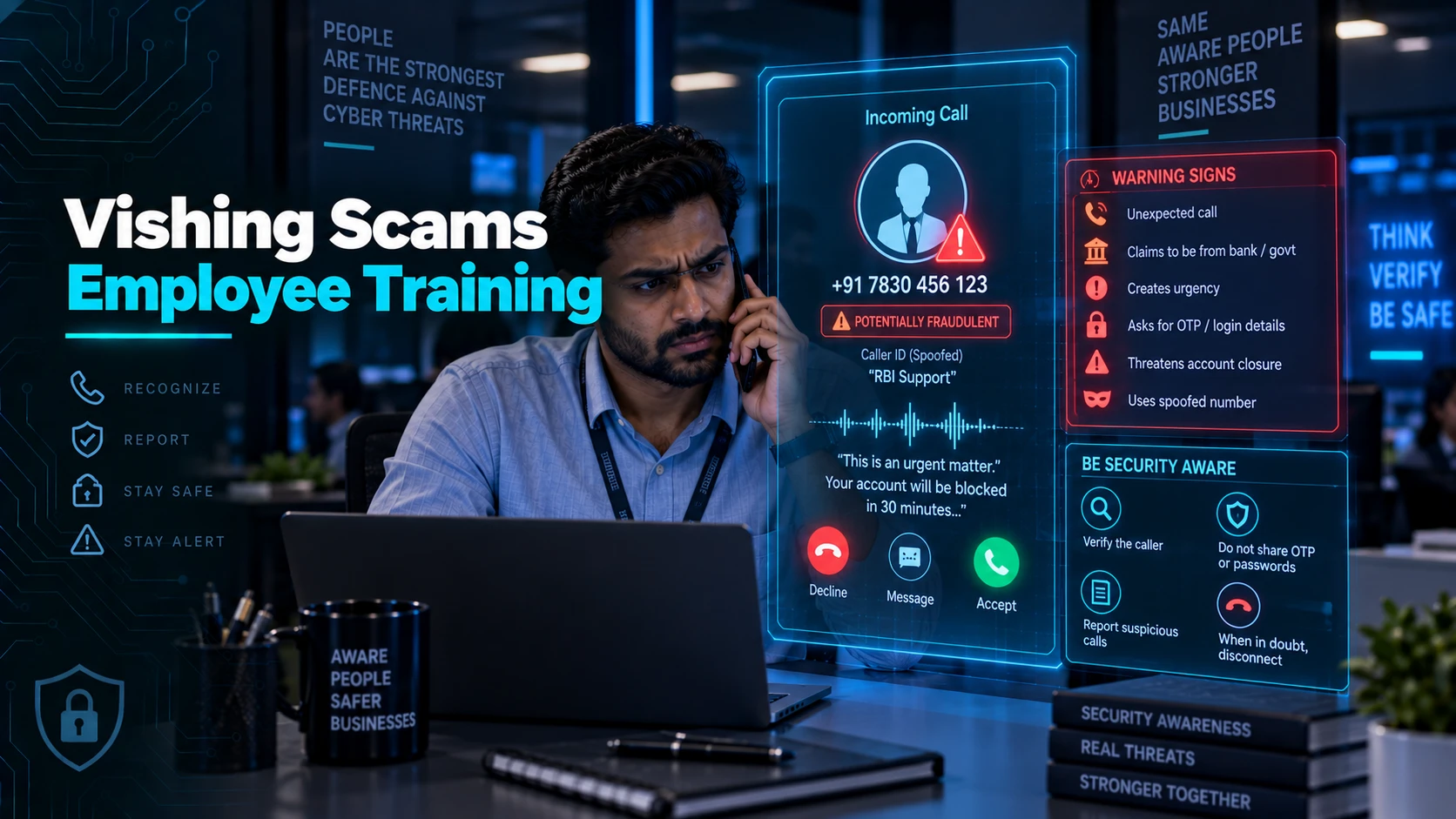
💡 In Simple Terms (For Beginners)
Vishing is a phone call version of phishing — a scammer calls pretending to be your bank, IT support, or a government office to trick you into sharing information or making a payment. It works even on people who are careful with email.
- A live phone call creates real-time social pressure that a written email doesn't — this is why vishing succeeds even against email-cautious employees.
- Caller ID can be spoofed, so a familiar-looking number is not proof of who's actually calling.
- Ending the call and calling back on a number you already have is the single most effective defence.
HUMAN FIREWALL · September 12, 2026 · 6 min read · By Hardik Patel
Why do phone scams still work even on security-aware employees? Vishing succeeds because a live call creates immediate social pressure and doesn't leave the same suspicious artifacts — misspelled sender addresses, odd links — that trained employees learn to spot in a phishing email.
Why a Phone Call Is a Different Threat Than an Email
A phone call gives a scammer real-time control over the conversation's pace and pressure in a way a written message can't — there's no pause to reread, no time to forward it to a colleague for a second opinion, and a skilled caller actively steers around hesitation as it happens.
Most phishing-awareness training focuses heavily on email red flags — sender address, links, attachments — which leaves a real gap for phone-based social engineering that doesn't share any of those specific markers.
Caller ID Is Not Proof of Identity
Caller ID can be spoofed to display a legitimate-looking number, including one matching a real bank or vendor — a scam call showing a bank's actual customer-service number on the display is a known, well-documented technique, not a rare edge case.
This means an employee trained to check "does the number look right" is checking a signal that offers no real protection once a caller has spoofed it.
How to Actually Train for This
Vishing-specific training needs to teach one core habit that doesn't depend on spotting a fake number or a suspicious tone: end any call requesting sensitive information or a payment action, then call back using a number you already have on file — never one the caller provided or that shows on the incoming call.
- Treat any unsolicited call asking for a password, OTP, or payment action as a trigger to hang up and verify independently.
- Never provide an OTP over the phone — no legitimate bank or service will ever ask for one.
- Practice the actual hang-up-and-callback habit in training scenarios, not just discuss it as a rule.
Key Takeaways
- Live calls create real-time pressure that written phishing doesn't, which is why email-trained employees can still fall for vishing.
- Caller ID can be spoofed — a familiar number is not verification.
- Hang up and call back on a known number is the one habit that defeats this regardless of how convincing the call sounds.
Frequently Asked Questions
Q: Is vishing the same as the WhatsApp impersonation or voice cloning scams already covered on this blog?
A: Related but distinct — vishing typically involves a live scammer impersonating an institution (a bank, telecom provider, government office) on a phone call, rather than cloning a specific known person's voice or messaging on WhatsApp. The core defence — verify independently, never trust the incoming channel — is the same across all three.
Q: Should employees just stop answering unknown calls?
A: Not necessarily practical for most business roles — the more reliable fix is training the hang-up-and-verify habit for any call that asks for sensitive information or a payment action, regardless of whether the call itself was answered.
How iTechFixr Can Help
Our Human Firewall training includes vishing scenarios alongside email and WhatsApp-based social engineering, so your team recognises the pattern across every channel it can arrive through.
Need Help With This?
Talk to Hardik directly about your organisation's cybersecurity needs — get a tailored response within 24 hours.